
15 Red Flags to Look for When Viewing a House: A Surveyor’s Guide
15 Red Flags to Look for When Viewing a House: A Surveyor’s Guide
Viewing a house is an exciting part of the property-buying process. However, attractive decoration, modern kitchens and well-presented interiors can sometimes distract buyers from more important issues relating to the condition of the building.
As residential surveyors, we regularly encounter defects that may not have been noticed during initial property viewings. Some are relatively minor maintenance issues, while others can result in substantial repair costs or require further specialist investigation.
Knowing what to look for when viewing a house can help you ask better questions, identify potential expenditure and make a more informed decision before submitting an offer.
In this guide, Aspect Surveying explains 15 common red flags to look for when viewing a property in the UK, what they might indicate and when you should seek professional advice.
What are the biggest red flags when viewing a house?
Pay particular attention to signs of structural movement, dampness, roof deterioration, uneven floors, ageing services and poorly constructed alterations.
- Significant or recurring cracks in walls.
- Visible damp staining, mould or damaged plaster.
- Sagging roofs or deteriorating roof coverings.
- Noticeably sloping or excessively springy floors.
- Extensions or alterations with uncertain approvals.
- Outdated electrical and heating installations.
These warning signs do not necessarily mean that a property should be avoided, but they may warrant further investigation before purchase.
15 warning signs to look for when viewing a property
1. Cracks in walls
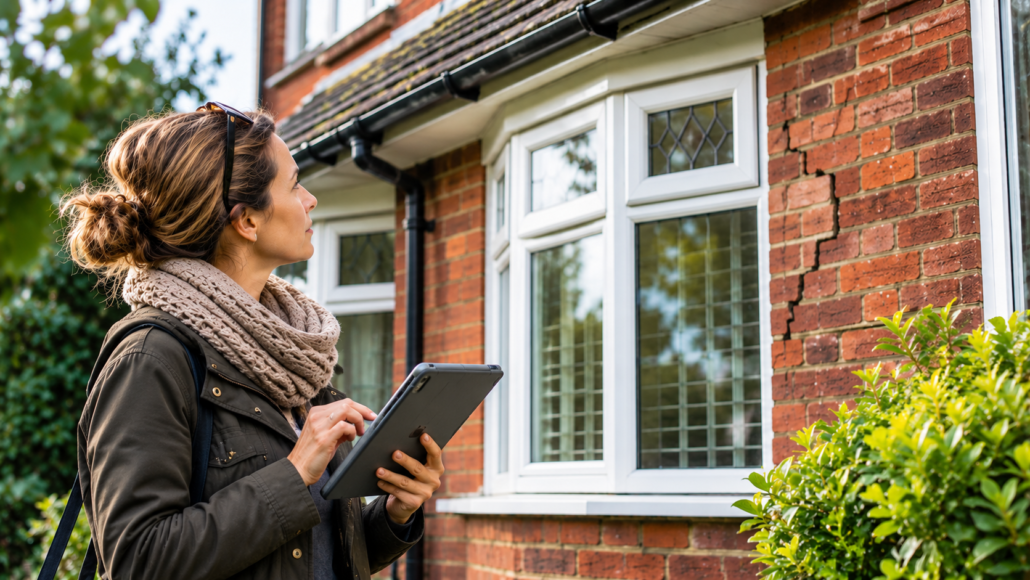
Cracking is one of the most common concerns raised by homebuyers. Although many cracks result from minor thermal movement or shrinkage, others may indicate more significant structural issues.
What to look for:
- Stepped cracks following mortar joints.
- Diagonal cracks around windows and doors.
- Cracks that continue through bricks.
- Corresponding internal and external cracking.
- Cracks that appear to have been repeatedly repaired.
Possible causes include historic settlement, subsidence, lintel failure and cavity wall tie corrosion.
The location, pattern and surrounding condition are often more important than crack width alone. A professional assessment may be required to establish the likely cause and significance.
2. Sagging roofs and deteriorating roof coverings
Roof repairs can represent a significant expense, particularly when complete renewal of the roof coverings is required.
Stand back from the property and look at the roof from ground level where it is safe to do so.
What to look for:
- Uneven or sagging rooflines.
- Missing, slipped or broken tiles and slates.
- Deteriorating ridge tiles.
- Leaning or damaged chimney stacks.
- Visible defects to flashings.
Older roofs may have limited secondary weather protection beneath the coverings. However, the age or appearance of a roof alone does not establish that it requires replacement.
A survey can help assess its condition and likely repair requirements.
3. Damp staining and damaged plaster
Dampness can affect properties of all ages and may result from several different sources of moisture.
What to look for:
- Discoloured walls and ceilings.
- Peeling wallpaper or blistering paint.
- White salt deposits on masonry or plaster.
- Deteriorating skirting boards.
- Persistent musty smells.
Potential causes include defective gutters, penetrating dampness, plumbing leaks, condensation and moisture rising from the ground.
It is important not to assume that all dampness at low level is rising damp. Correctly identifying the source is essential before undertaking remedial works.
4. Condensation and mould growth
Condensation is particularly common in kitchens, bathrooms, bedrooms and properties with inadequate ventilation or inconsistent heating.
What to look for:
- Black mould around windows.
- Mould in external wall corners.
- Persistent condensation on glazing.
- Bathrooms without suitable extraction.
- Musty cupboards and poorly ventilated rooms.
Condensation may relate to occupant behaviour, inadequate heating, ventilation deficiencies, cold surfaces or a combination of these factors.
Cleaning or redecorating affected surfaces without addressing the underlying cause may result in the problem returning.
5. Uneven, sloping or springy floors
Older properties frequently have some degree of floor unevenness due to historic movement and the natural characteristics of timber construction.
However, pronounced slopes or excessive movement may warrant further investigation.
What to look for:
- Noticeably sloping floors.
- Excessive movement under normal foot traffic.
- Localised depressions.
- Gaps between floors and skirting boards.
- Associated cracking to walls or ceilings.
Possible causes include historic settlement, inadequate support, alterations to structural elements or deterioration of concealed floor timbers.
The presence of an uneven floor does not automatically indicate ongoing structural movement.
6. Sticking doors and windows
Doors and windows that are difficult to open or close may simply require adjustment or routine maintenance.
However, widespread distortion can sometimes indicate movement affecting the surrounding structure.
What to look for:
- Doors rubbing against their frames.
- Uneven gaps around door openings.
- Distorted window frames.
- Cracking above windows and doors.
- Failed double-glazed units.
Where several openings are affected and associated cracking is present, a more detailed assessment may be appropriate.
Ask the seller or estate agent before operating windows or doors during a viewing.
7. Recently decorated or concealed areas
Fresh decoration is common when preparing a property for sale and should not automatically be regarded as suspicious.
Nevertheless, isolated areas of new paint or plaster may make it more difficult to identify previous defects.
What to look for:
- Recently painted lower sections of walls.
- Localised patches of new plaster.
- Fresh decoration around chimney breasts.
- Heavy furniture obscuring external walls.
- New finishes in otherwise dated rooms.
Ask whether any recent repairs or damp treatment have been undertaken and whether supporting documentation or guarantees are available.
Do not assume that fresh decoration is evidence of a concealed problem.
8. Deteriorating or distorted brickwork
The external walls can provide useful clues about the overall condition of a property.
What to look for:
- Horizontal cracking along mortar joints.
- Bulging or leaning walls.
- Cracking above window openings.
- Damaged or spalling brick faces.
- Significantly deteriorated mortar joints.
Horizontal cracking in cavity walls may sometimes be associated with wall tie corrosion, while cracking above openings can indicate issues with lintels or other supporting elements.
These defects can have several possible causes and should be assessed in the context of the building’s age and construction.
9. Defective gutters and drainage
Rainwater goods are often overlooked during property viewings, despite their importance in protecting the building from moisture penetration.
What to look for:
- Leaking or disconnected downpipes.
- Sagging or overflowing gutters.
- Green staining on external walls.
- Standing water near the building.
- Damaged or blocked drainage gullies.
Defective rainwater disposal can contribute to penetrating dampness, deterioration of masonry and damage to internal finishes.
Where water is repeatedly discharged close to the building, drainage and ground conditions may also require consideration.
10. High external ground levels
Patios, driveways and raised garden areas can sometimes be installed too close to the damp-proof course or obstruct ventilation beneath suspended timber floors.
What to look for:
- Paving close to internal floor level.
- Partially buried air bricks.
- Soil built up against external walls.
- Patios sloping towards the property.
- Low-level damp staining internally.
Where a conventional damp-proof course is present, external ground levels are generally expected to remain at least 150mm below it, subject to the construction and detailing of the building.
Inadequate clearance or restricted subfloor ventilation may increase the risk of dampness and concealed timber deterioration.
11. Poorly constructed extensions and alterations
Extensions, loft conversions and removed internal walls can improve a property considerably, but poorly executed alterations may introduce structural, moisture-related or regulatory concerns.
What to look for:
- Cracking where extensions meet the original building.
- Uneven floors between rooms.
- Signs of leakage at roof junctions.
- Converted lofts with unusual access arrangements.
- Large openings where walls have been removed.
Ask whether relevant planning permissions, Building Regulations approvals and completion certificates are available.
Your solicitor should investigate the legal documentation, while your surveyor can comment on the visible condition of the alterations and identify matters requiring further investigation.
12. Outdated electrical installations
Electrical modernisation can represent a substantial expense, particularly where a property requires a complete rewire.
What to look for:
- Very old fuse boxes.
- Damaged sockets and switches.
- Visible deterioration of electrical fittings.
- Limited socket provision.
- Signs of improvised electrical alterations.
The appearance of an electrical installation does not establish whether it is safe or compliant with relevant standards.
Ask whether a recent Electrical Installation Condition Report (EICR) is available. Where concerns exist, an inspection by a suitably qualified electrician should be considered before purchase.
Do not remove covers or attempt to inspect live electrical components during a viewing.
13. Ageing heating systems
Heating systems can be expensive to replace, particularly where wider upgrades to pipework, radiators or controls are required.
What to look for:
- An older boiler or heating appliance.
- Corroded radiators.
- Visible leaks around pipework.
- Outdated heating controls.
- Rooms without adequate heating provision.
Ask about the age of the boiler, its servicing history and whether relevant installation documentation is available.
A suitably qualified heating engineer can assess the condition, operation and safety of the system. Gas appliances should be assessed by a Gas Safe registered engineer.
14. Large trees close to the property
Mature trees can be attractive features and do not necessarily present a problem. However, their proximity to a building may warrant consideration, particularly where shrinkable clay soils are present.
What to look for:
- Large trees close to external walls.
- Associated structural cracking.
- Raised or damaged paving.
- Overhanging branches affecting the roof.
- Evidence of drainage problems.
The potential influence of trees depends on factors including species, soil type, foundation depth, tree size and distance from the building.
Do not assume that a tree needs to be removed. In some circumstances, inappropriate removal can introduce additional ground movement risks.
15. Non-standard property construction
Not all houses are constructed using conventional brick or stone masonry. Some properties incorporate concrete panels, steel frames, timber systems or other construction methods.
What to look for:
- Unusual external wall finishes.
- Visible panel joints.
- Concrete or metal structural components.
- Extensive external wall insulation.
- Unusual building designs or construction details.
These features do not necessarily confirm non-standard construction, but they may justify further enquiries.
Certain construction systems can affect mortgage availability, insurance, future maintenance and resale prospects.
Where non-standard construction is suspected, the specific system should be established and its acceptability confirmed with your mortgage lender and insurer.
Which property red flags are the most serious?
Not every defect carries the same level of risk. Some issues can be addressed through routine maintenance, while others may involve significant expenditure, safety concerns or uncertainty regarding the structural condition of the building.
| Warning sign | Potential concern | Recommended action |
|---|---|---|
| Significant structural cracking | Possible structural movement | Survey and specialist assessment where recommended |
| Bulging or leaning walls | Potential structural instability | Prompt professional assessment |
| Persistent dampness | Moisture penetration or concealed deterioration | Identify the source and obtain repair advice |
| Sagging roof structure | Possible deterioration or inadequate support | Detailed roof and structural assessment |
| Outdated electrical installation | Potential safety and modernisation concerns | Electrical inspection where appropriate |
| Undocumented structural alterations | Structural and regulatory uncertainty | Survey and solicitor enquiries |
| Non-standard construction | Potential lending and maintenance implications | Confirm construction type and lender requirements |
| Minor decorative deterioration | Generally maintenance-related | Allow for repairs and monitor where appropriate |
The significance of each issue depends on the individual property. The table provides general guidance and should not be used as a substitute for a professional assessment.
A surveyor’s perspective
A property with visible defects is not necessarily a poor purchase. Equally, a property that appears to be in excellent decorative condition may have significant underlying problems.
The important consideration is whether you understand the nature of any defects, the likely repair requirements and the financial implications before committing to the purchase.
Our Property Defects Hub provides further guidance on common building defects, their potential causes and implications.
What questions should you ask when viewing a house?
A property viewing is an opportunity to obtain useful information from the seller or estate agent. Consider asking the following questions, particularly where the property is older or has undergone alterations.
Questions to ask the seller
- How old is the roof, and has it been repaired or replaced?
- Has the property experienced any dampness or water penetration?
- Have there been any previous structural repairs?
- Has the property ever been affected by subsidence or flooding?
- When was the electrical installation last inspected or upgraded?
- How old is the boiler, and when was it last serviced?
- Have any walls been removed or structural alterations undertaken?
- Are approvals and completion certificates available for extensions?
- Are there guarantees for previous remedial works?
- Are there any known drainage or maintenance issues?
Where important information is provided verbally, ask your solicitor to obtain appropriate written confirmation and supporting documentation.
Should you walk away from a house with red flags?
Discovering potential defects during a viewing does not necessarily mean that you should withdraw your interest in the property.
Many older houses require repairs and modernisation, and these requirements may already be reflected in the asking price.
Before deciding whether to proceed, consider:
- The likely seriousness of the defects.
- Whether the underlying causes can be established.
- The anticipated cost of repairs.
- Whether further specialist investigations are required.
- Any implications for mortgage lending or insurance.
- Whether you have sufficient funds for necessary works.
- Whether the agreed purchase price reflects the property’s condition.
Obtaining an independent survey and appropriate repair quotations can help you make a more informed decision about whether the property represents a suitable purchase.
Can you identify all property defects during a viewing?
No. A typical property viewing is relatively short and is primarily intended to help you decide whether the property meets your requirements.
Many building defects are difficult to identify without an understanding of construction methods, building pathology and the relationship between different building elements.
Some problems may also be concealed behind finishes, beneath floors or within inaccessible parts of the building.
A property viewing is not a building survey
Even if you do not identify any obvious warning signs during your viewing, this does not mean that the property is free from defects.
Equally, a professional home survey is generally non-invasive and cannot guarantee the identification of every concealed defect. Further investigations may be recommended where appropriate.
Read our guide on whether a house survey is worth it to understand the benefits of obtaining independent professional advice before buying.
Which survey should you arrange if you notice red flags?
The most appropriate survey will depend on the property’s age, construction, condition and the nature of the concerns identified during your viewing.
An RICS Level 2 Home Survey is generally suitable for conventionally constructed properties in reasonable condition. Where a property is older, significantly altered, in poor condition or has more complex defects, an RICS Level 3 Building Survey may be more appropriate.
RICS Level 2 Home Survey
Suitable for many conventional residential properties without obvious significant defects or extensive alterations.
- Assessment of visible building elements.
- Identification of significant defects.
- Condition ratings.
- Repair and maintenance advice.
- Recommendations for further investigations.
RICS Level 3 Building Survey
A more detailed survey that is particularly useful for older, unusual, substantially altered or poorly maintained properties.
- More detailed assessment of construction.
- Discussion of defects and likely causes.
- Advice regarding repair options.
- Potential consequences of deterioration.
- Further investigation recommendations.
If you identify a particular concern during your viewing, explain this to your surveyor when arranging the inspection so that the issue can be considered within the agreed scope of the survey.
For most buyers, the ideal time to commission an independent inspection is shortly after an offer has been accepted. Our guide on when to arrange a house survey explains how this fits into the wider purchasing process.
Your practical house-viewing checklist
Consider using the following checklist during your next property viewing. It covers some of the key areas that are frequently overlooked by prospective buyers.
Outside the property
- Look at the roofline and roof coverings.
- Check for visible chimney deterioration.
- Look for external wall cracking.
- Check the condition of brickwork and mortar.
- Observe gutters and downpipes.
- Check external ground levels.
- Look for obstructed air bricks.
- Consider nearby trees and drainage.
- Look at extensions and their junctions.
Inside the property
- Look for cracks in walls and ceilings.
- Check for visible damp staining.
- Look for condensation and mould.
- Notice uneven or excessively springy floors.
- Observe window and door condition.
- Look at accessible electrical fittings.
- Ask about the boiler and heating system.
- Check ventilation in kitchens and bathrooms.
- Ask about previous repairs and alterations.
Only inspect areas that are safely accessible and for which you have permission. Do not climb onto roofs, enter unsafe loft spaces, lift floor coverings or interfere with electrical, gas or other installations.
Frequently asked questions
What is the biggest red flag when viewing a house?
Evidence of significant structural movement, such as substantial cracking accompanied by distortion or bulging walls, is among the more important warning signs. However, a professional assessment is required to determine the cause and seriousness of the issue.
Should I worry about cracks when viewing a house?
Not necessarily. Minor cracking is common in residential properties and can result from shrinkage, thermal movement or historic settlement. More significant cracking, particularly where associated with distortion or other signs of movement, should be professionally assessed.
Is damp a reason not to buy a house?
Dampness does not automatically mean that a property should be avoided. Many damp problems can be resolved through appropriate repairs, improved ventilation or maintenance. The important consideration is identifying the underlying cause and understanding the likely cost of remedial works.
What should I look for when viewing an older house?
Pay particular attention to the roof, chimney stacks, external walls, dampness, timber floors, ventilation, drainage and the condition of electrical and heating installations. Previous alterations and the suitability of repair materials should also be considered.
Does fresh paint mean the seller is hiding damp?
No. Fresh decoration is common when preparing a property for sale. However, recently decorated surfaces can make previous staining or defects more difficult to identify. Ask whether any recent repairs or damp treatment have been undertaken.
Should I arrange a second viewing before making an offer?
A second viewing can be useful, particularly if you are seriously considering purchasing the property. It provides an opportunity to look more carefully at the building, ask additional questions and consider potential maintenance requirements.
Can I negotiate the price if I notice defects during a viewing?
Yes. You can take visible defects and anticipated repair costs into account when deciding how much to offer. A professional survey and supporting contractor quotations may provide a stronger basis for subsequent negotiations, although the seller is not obliged to accept a reduced offer.
Will a mortgage valuation identify these red flags?
A mortgage valuation is primarily intended to assess the suitability of the property as security for the lender. It is not designed to provide the purchaser with a comprehensive assessment of the building’s condition and repair requirements.
Do I need a survey if the house looks well maintained?
An independent survey is recommended even where a property appears to be well maintained. Attractive decoration and modern fittings do not necessarily reflect the condition of the roof, structure, concealed timbers or other important building elements.
Can a surveyor advise me whether to buy the property?
A surveyor can provide an independent assessment of the property’s condition, explain identified defects and advise on repairs and further investigations. This information can help you make an informed purchasing decision, although the final decision remains yours.
Buy your next property with greater confidence
Whether you have identified potential red flags during a property viewing or simply want reassurance about the condition of your prospective home, an independent survey can help you understand what you are buying.
At Aspect Surveying, we provide professional RICS Level 2 Home Surveys and RICS Level 3 Building Surveys across Manchester, Greater Manchester, Cheshire and surrounding areas.
Our reports include photographs, clear explanations of identified defects, prioritised recommendations and practical advice regarding repairs, maintenance and further investigations.
You can explore our sample survey reports to understand the level of detail we provide or contact our team for advice on selecting the most appropriate survey for your property.
Understanding the condition of a property before exchanging contracts can help you anticipate expenditure, reduce uncertainty and make a more informed purchasing decision.